Today I'd like to share this short video on the Aesthetic Movement. This dramatically important 30+ year period influenced and altered 20th Century design and art. Unknown to most Americans, it begat the Arts & Crafts Movement in England that quickly emigrated to the United States, becoming a strong influencer of style and design throughout the past century.
The images shown and spaces visited in this video are some of the most sumptuous and decadently beautiful things human-created from the past 200 years, you would be wise to watch it full screen for the most impact.
Cult of Beauty: The Aesthetic Movement 1860-1900 from Victoria and Albert Museum on Vimeo.
Thursday, March 3, 2016

Tuesday, March 1, 2016
The Victorian Period and Associated Styles

note: my purpose here is not to convey every single bit of information about Victorian Period styles, but to showcase the differences to help you begin to understand some of the more popular decorative styles of the 19th Century/Victorian Period.
Queen Victoria ascended the throne on June 20, 1837, where she remained the Queen of the United Kingdom of Great Britain and Ireland until her death on May 1, 1901.
As with the British monarchs before her, she lent her name to the period of time when she ruled. This 64-year time frame is known as the Victorian Period.
"Victorian Style"
Most importantly, there is no "Victorian style." This term refers to something that just plain doesn't exist. Style and Period are not the same.
Can you imagine if only one style of clothes lasted for 64 years? Style changes faster and faster as time goes on. There were many changes in style during the 64 years of the Victorian Period.
The industrial revolution gave us telephones, telegraph, gas light, and electric light: nearly all of these achievements associated with the Victorian Period. Even paint didn't escape development: The first artificial colors and latex paints were developed in the mid and late 19th century. Technology impacted style just like it does today (think of how much the original iMac influenced the style. of the 1990s) Advances that were novel, fantastical and insanely modern, then, look old-fashioned to some now. In ten years, you'll feel the same way about those pants you're wearing.

The Gothic Revival, one of many revival styles, looked back to the original Gothic (medieval period) style and displayed Gothic arches, trefoils and clean, geometrically patterned fabrics. Colors, too were influenced by the original style when primary, flat colors, like blue, yellow and emerald green, were used in fabrics, stained glass and, most notably, in church decoration. Often, modern viewers of this style think that everything in a Gothic Revival style was in a church. The Gothic Revival was commonly used for public buildings of all sorts and often in homes.

The Rococo Revival, like the earlier Gothic Revival, looked to the historic Rococo period (a short-lived period immediately after the Baroque Era) and it's associated florid shapes. Straight lines were banished and natural curves are used to produce visually delicate furniture. Strongly associated with the south, this style was common throughout the country and often was used in Italianate style homes, contrasting with the geometry of this Italian-Renaissance-inspired style. Laminated woods, a technological development tied to the early part of the 19th century, enabled those huge swaths of wood for the fully carved and curved backs of this feminine furniture. Fabrics were sumptuous and red is commonly associated with this style. John Henry Belter is the most well-known designer of this style.

This whollly American style grew out of observed Renaissance era motifs and French furniture design. Architectural and impressive, it was most popular in the industrial north where Victorian era robber barrons put their newly earned wealth on display. Impressive, richly colored fabrics in silk and velvet were popular. Deep button tufting was revived from the Rococo Revival to adorn these often over the top pieces. Often associated with the late-Italianate and Second Empire architectural styles, the furniture and buildings shared common massing and motifs. John Jelliff and Thomas Brooks were popular designers working in this style.


Even revival styles were revived. The Neo Gothic style is sometimes called Eastlake since Charles Eastlake, the Martha Stewart of the late 19th century, espoused this simple, functional and Medieval-inspired style. Kimmel and Cabus worked in this style and their furniture is highly desirable now. More simplistic and without the "churchy" association of other Gothic styles, this style proposed to authentically reproduce the furniture and architecture of the Medieval Period and often includes coloring by fuming and a simple finish of wax.
 Yes, indeed, the Colonial Revival was a Victorian Period style. Begun about the time of the United States' Centennial in 1876, this style has had many variations of it's own, all looking back with varying degrees of authenticity to various aspects of Colonial America for inspiration. It continues, uninterrupted, to this day.


Can you imagine if only one style of clothes lasted for 64 years? Style changes faster and faster as time goes on. There were many changes in style during the 64 years of the Victorian Period.
The industrial revolution gave us telephones, telegraph, gas light, and electric light: nearly all of these achievements associated with the Victorian Period. Even paint didn't escape development: The first artificial colors and latex paints were developed in the mid and late 19th century. Technology impacted style just like it does today (think of how much the original iMac influenced the style. of the 1990s) Advances that were novel, fantastical and insanely modern, then, look old-fashioned to some now. In ten years, you'll feel the same way about those pants you're wearing.
Victorian Styles
To give you a quick primer on the many styles of the Victorian Period, let's look at a few chairs. Chairs are great. They always embody almost everything about the nuances of a particular style. In every style, era, or period, chairs were and are a necessary part of daily life. You can find a chair to represent even the most fleeting sub-styles.
Here are a handful, in rough chronological order, with some of the technology that made that style possible. I hope that you'll see that everyone of these styles is really, really different from the others—crazy different. But they are all "Victorian."

Gothic Revival
The Gothic Revival, one of many revival styles, looked back to the original Gothic (medieval period) style and displayed Gothic arches, trefoils and clean, geometrically patterned fabrics. Colors, too were influenced by the original style when primary, flat colors, like blue, yellow and emerald green, were used in fabrics, stained glass and, most notably, in church decoration. Often, modern viewers of this style think that everything in a Gothic Revival style was in a church. The Gothic Revival was commonly used for public buildings of all sorts and often in homes.
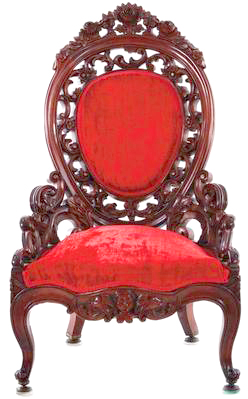
Rococco Revival
The Rococo Revival, like the earlier Gothic Revival, looked to the historic Rococo period (a short-lived period immediately after the Baroque Era) and it's associated florid shapes. Straight lines were banished and natural curves are used to produce visually delicate furniture. Strongly associated with the south, this style was common throughout the country and often was used in Italianate style homes, contrasting with the geometry of this Italian-Renaissance-inspired style. Laminated woods, a technological development tied to the early part of the 19th century, enabled those huge swaths of wood for the fully carved and curved backs of this feminine furniture. Fabrics were sumptuous and red is commonly associated with this style. John Henry Belter is the most well-known designer of this style.

Renaissance Revival
This whollly American style grew out of observed Renaissance era motifs and French furniture design. Architectural and impressive, it was most popular in the industrial north where Victorian era robber barrons put their newly earned wealth on display. Impressive, richly colored fabrics in silk and velvet were popular. Deep button tufting was revived from the Rococo Revival to adorn these often over the top pieces. Often associated with the late-Italianate and Second Empire architectural styles, the furniture and buildings shared common massing and motifs. John Jelliff and Thomas Brooks were popular designers working in this style.

Neo Grec
Sometimes thought of as a sub-style to Renaissance Revival, this was a short-lived high-style movement that influenced elite brownstone townhouses in New York and the furniture that wealthy tastemakers chose to place within them. Sometimes referred to as New Greek or incorrectly as Greek Revival (a wholly different period some 20-30 years earlier), inspiration for this style was derived from Ancient Greek and Roman sources such as anthemion, greek key and acanthus motifs, as well as Ancient Roman and Japanese sources. Polychromy, coloring the furniture in multi-colored finishes, was popular, as was ebonizing, a finishing technique meant to imitate ebony wood or Japanese lacquered items. Leon Marcotte created some outstanding furniture in the Neo Grec style.
Neo Gothic
Even revival styles were revived. The Neo Gothic style is sometimes called Eastlake since Charles Eastlake, the Martha Stewart of the late 19th century, espoused this simple, functional and Medieval-inspired style. Kimmel and Cabus worked in this style and their furniture is highly desirable now. More simplistic and without the "churchy" association of other Gothic styles, this style proposed to authentically reproduce the furniture and architecture of the Medieval Period and often includes coloring by fuming and a simple finish of wax.

Colonial Revival
Yes, indeed, the Colonial Revival was a Victorian Period style. Begun about the time of the United States' Centennial in 1876, this style has had many variations of it's own, all looking back with varying degrees of authenticity to various aspects of Colonial America for inspiration. It continues, uninterrupted, to this day.Louis Revivals
To some, this style is closely associated with the Colonial Revival, since the variants are still popular with interior designers, today. Imitating the various French styles associated with a line of Louis monarchs, this style uses feminine forms, pale fabrics and a great deal of gold and white. Typically used in the parlors of homes of Victorian "old money" families, such as the Vanderbilts and Astors, this style is always an indication of conservative wealth.


Innovation Style
Capitalizing entirely on new technologies developed during the Industrial Revolution, this style can be super modern in appearance, even after 100+ years. As machinery made possible new treatments to shape wood and metal, designers showcased these technologies in furniture design, such as this Hunzinger-designed rocker that doesn't fold, but looks as if it does. The "upholstery" is novel, too, made up of flat wires that are wrapped in brightly colored fabrics and meant to be shown. The rocker even has groves cut into the wood that are colored to match the fabric wrapped wires. The bent-wood armchair is by the Viennese furniture maker, Thonet, who steam-bent wood to create curvaceous furniture that feels like summer. Hunzinger and Thonet both hold many patents on their furniture technology.Cottage
This style came about in the 1870s but became super popular in the late 1890's and into the 20th century. It is often simple in design and commonly uses Renaissance Revival massing with faux graining and scene paintings to decorate the simple pine furniture, carrying on ancient European traditions of decorating cheap furniture to appear more expensive. It was popular with normal Victorian people. Also included are wicker pieces, even though some wicker was produced within the styles listed above (yeah, its confusing, I know). A wicker chair by Heywood Wakefield is shown. Cottage furniture was often used in bedrooms and sunrooms, or a piece or two added to a more formal room to show visitors how cozy the family was. After the turn of the 20th century wicker pieces moved outdoors and the painted pine pieces all but disappeared.Wednesday, January 20, 2016
New Exterior Paint
We did the painting this past summer - can't believe I am just now getting around to posting this.
The pictures speak for themselves
The pictures speak for themselves
 |
| BEFORE - thanks Google Maps |
 |
| Before form the same angle as below |
 |
| After - even the sidewalk was redone (in brick) |
 |
| One of my favorite views |
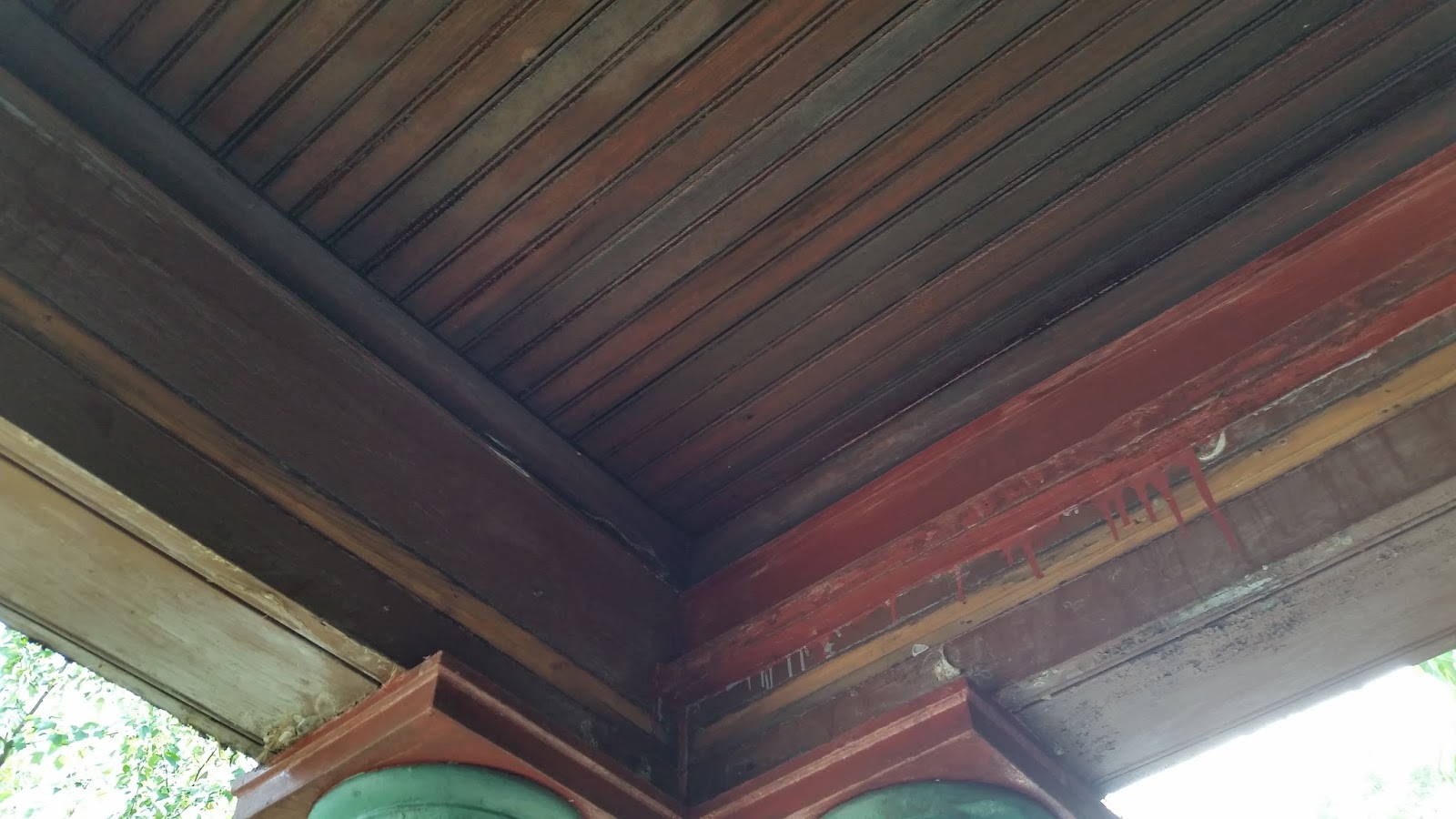 |
| Boy does this look messy - aluminum flashing removed - old paint exposed - evidence of trim that was removed - see below for after. |
 |
| Before - Rafter tails covered over by tons of aluminum flashing |
 |
| After - no more flashing - and we replaced the removed trim both inside and out. |
Friday, December 25, 2015
Bath Remodel (part 3 of 4)
This is part 3 of the first floor bathroom remodel.
See previous entries: Part 1; Part 2.
Since the last entry the bathroom has been painted on one side only. The old sink and toilet were cleaned/refurbished and were installed along with new water shut-off valves and bendable, rather than corrugated, water supply lines. The bendable smooth water supplies are more period correct than the flexible braided type found at big box stores.
The water supplies and shut off valves came form Signature Hardware and repeat the cross-handles found on the shower hardware.
Really, if I was only concerned with keeping the room on track, I would have painted all at once. We had to make this first floor bathroom usable for a holiday party. this limitation gave me a chance to show off the unfinished side's structure. I think that it's educational for guests to see and ask about the "during" phase of home restoration. They often believe that home restoration is mystical or too hard and in this way can see how simple and straightforward it can be. Maybe, hopefully, they will even rethink tearing out old historical features in favor of anything new (and probably with questionable taste.)
Below are a couple of photos of the finished paint, just before installing the fixtures.
The paint color, by-the-way, is a pale warm grey. It's very period and was used often in service areas. Sometimes referred to as drab (light drab in this case) it is utilitarian and easy to live with. It is the color of brushed nickel that has aged and obtained the smooth golden patina of 150 years. It is the color of dried straw that was left in the sun a bit too long. It is lovely and antique and modern all at the same time. It looks stunning with the pale pink ceiling and will carry into the adjacent hall and kitchen very well when we rework those areas.
See previous entries: Part 1; Part 2.
Since the last entry the bathroom has been painted on one side only. The old sink and toilet were cleaned/refurbished and were installed along with new water shut-off valves and bendable, rather than corrugated, water supply lines. The bendable smooth water supplies are more period correct than the flexible braided type found at big box stores.
The water supplies and shut off valves came form Signature Hardware and repeat the cross-handles found on the shower hardware.
 |
| Before ... ugh |
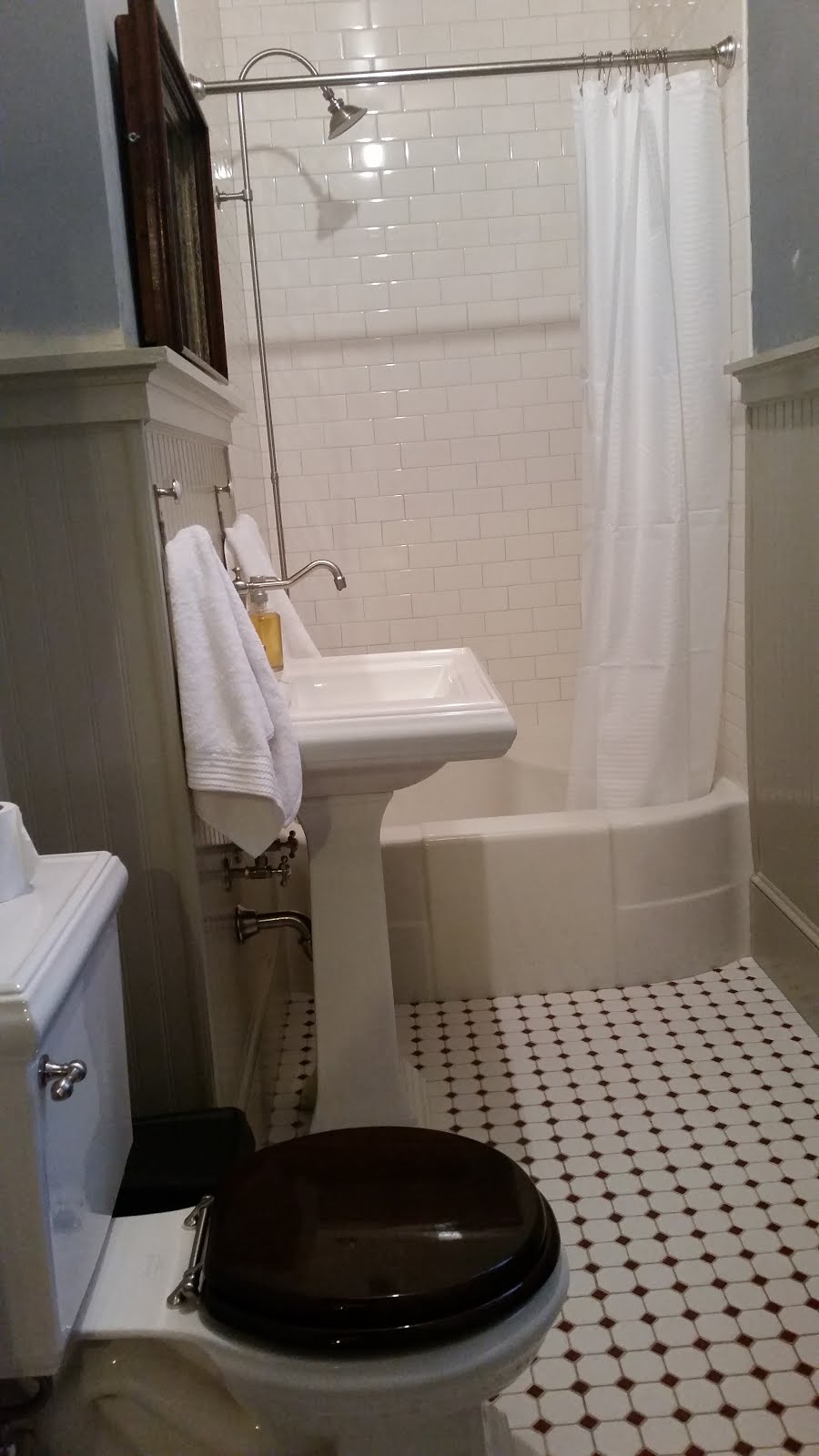 |
| After ... sans wall paper - yet to be installed. |
Why didn't you just paint the whole room and then install the fixtures?
Really, if I was only concerned with keeping the room on track, I would have painted all at once. We had to make this first floor bathroom usable for a holiday party. this limitation gave me a chance to show off the unfinished side's structure. I think that it's educational for guests to see and ask about the "during" phase of home restoration. They often believe that home restoration is mystical or too hard and in this way can see how simple and straightforward it can be. Maybe, hopefully, they will even rethink tearing out old historical features in favor of anything new (and probably with questionable taste.)
Below are a couple of photos of the finished paint, just before installing the fixtures.
The paint color, by-the-way, is a pale warm grey. It's very period and was used often in service areas. Sometimes referred to as drab (light drab in this case) it is utilitarian and easy to live with. It is the color of brushed nickel that has aged and obtained the smooth golden patina of 150 years. It is the color of dried straw that was left in the sun a bit too long. It is lovely and antique and modern all at the same time. It looks stunning with the pale pink ceiling and will carry into the adjacent hall and kitchen very well when we rework those areas.
 |
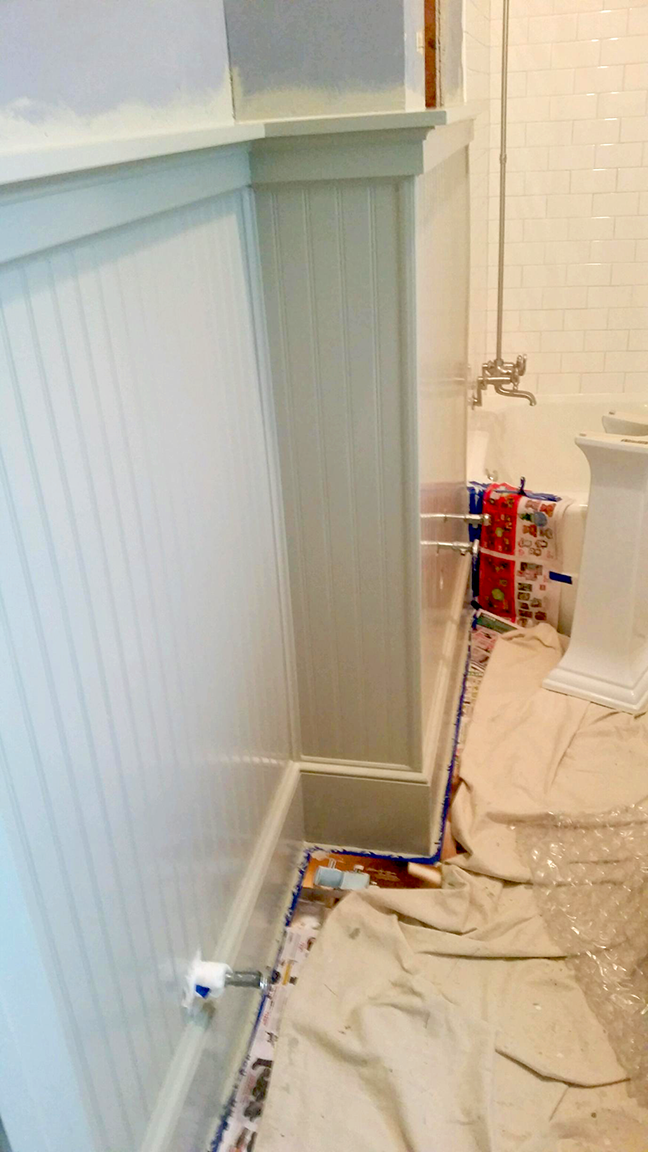
| The top part of the wall is primer. |
 |
| that bit of white paper towel is because we have to repair a leaking nipple connection for the toilet inlet line. |
 |
| This corner includes a new double outlet where a 1940s electric heater used to be. We couldn't figure out a good spot to mount the toilet paper holder so we got a free-standing one. |
 |
| In order to save a few dollars we didnt tear out the floor - plus its appropriate to the era. I don't care for the maroon tiles, so to lessen the impact I am adding dark walnut things to the room - a couple of mirror frames and a cool toilet seat I found. |
 |
| Reused the old sink with a new faucet. |
Monday, December 14, 2015
Bath Remodel (part 2 of 4)
This is part 2 of the first floor bathroom remodel.
See previous entry: Part 1
In part 1, I left off where the shower had been retiled and new faucet and shower head installed. Since then the walls have been patched, electrical repaired and repurposed and lower walls clad in bead board and cap and baseboard trim.
See previous entry: Part 1
In part 1, I left off where the shower had been retiled and new faucet and shower head installed. Since then the walls have been patched, electrical repaired and repurposed and lower walls clad in bead board and cap and baseboard trim.
 |
| General overview of the room with woodwork in place, but before any cleaning and painting. Even so, it looks pretty darned good since its last inception. |
 |
| First sections of bead board go up. No, its not real beaded board that is hung similar to T&G floors, but it'll do. The outlet is where a terrible old huge heater was circa 1940's. Reused the electric for the outlets, which the room lacked. |
 |
| Same as above but with baseboard and cap in place. note notched cap for the wall switch - easier to notch the wood than to move electrical. |
 |
| The Sink Wall ready for caulk and paint. The floor still needs to be scrubbed and the scuffs on the wall removed before painting. |
 |
| More electrical excitement: This is the recess behind where the old medicine cabinet was. The previous cabinet was a chromed 1940's behemoth that looked more like a Chrysler than a medicine cabinet. It had 2 lights integral to the structure that were fed by a single electrical line to the top of the cabinet. That line was split into 2 for some 1880's Bradley and Hubbard sconces that I will add to either side of a custom built medicine cabinet with an antique walnut framed mirror. |
Tuesday, November 24, 2015
Now You See It ... Now It's a Bathroom ?
Being socially upwardly mobile and influential was pretty darned important to some Victorian era folks. Anyone with any level of aspiration to success needed to have a full tool belt for those sticky society events and stuffy silver-drenched dinners. The family who built my home must have been "those kind of people." Off the kitchen was a fairly large butlers pantry - about 12 x 5 - with shelves that stretched floor to ceiling across at least 2 walls. The broad boards of those shelves must have groaned under the weight of stacks of dinner plates, luncheon plates, salad plates, soup plates, tea cups, coffee cups, after-dinner cups, saucers of various sizes, sherbets, crystal in 25 different shapes for at least 24 people, and silver. Silver dinner forks, place spoons, salad forks, oyster forks, after-dinner spoons, fruit knives and matching tiny fruit forks, grapefruit spoons, ice cream spoons (with tiny teeth to stab those cold-frozen chunks), seafood forks, soup and bullion spoons, tea spoons, soup ladles, meat forks, asparagus servers, pancake servers ... you get the picture.
And the dining room, where the art of the dinner took place, was, and still is, substantial without being cavernous: The perfect canvas to lay out this implements and soar skyward into high-society.
In about 1947, though, while the prosperous Hack family lived in the house, the earnest butlers pantry was demolished and a full bathroom was installed into the space. Plastic tile was chosen to grace the walls and a cinderella tub was dropped into a space that was made smaller with the addition of a wall, which also hid the vent stack for the plumbing (and preserved some superb evidence of the room's original purpose.)
This Autumn we decided to undo the band-aid fixes that this bathroom had seen over the past 60 years and install something more period appropriate to the house, albeit, still not a butlers pantry.
What follows is a pictorial story about making the bathroom once again sound and safe, as well as pleasing and more period correct. Sure, we could have gone with the 40's style, since that is correct for when the room became a bath, but we did that in the second floor and we really wanted something that looked and felt older, more in keeping with the formal rooms where guests will gather for some new century social ladder climbing.
(notes: thanks to Repko Renovations for the excellent tub surround build. This is part 1 of a few - You'll know when it ends, ha ha)
 |
| Here's the best before photo. Notice that the tile surround above the tub is white ceramic. Not sure when this was changed from the plastic or if it always was ceramic. It's a mess, though, with cracks, missing grout, and a strange indent that surrounds the faucet. The burgundy wallpaper ends where a drop ceiling hung. We gained a foot and a half of height by taking that thing out and repairing the ceiling. |
 |
| With the old plaster removed you can see the structure of the house's exterior walls. The house is built of solid brick with stone veneer. In some places on exterior walls there is lath and plaster, while in others the plaster is placed directly onto the brick, as you can see here. The tan colored square pattern is adhesive residue from the plastic tiles. You'll see it more thought these photos. |
 |
| Behind the "new wall" which extends into the room a foot, you can see untouched yellow oil paint from the original pantry. If you look carefully, the dark outlines of the lower cabinets, still with the wall paper that lined the interiors (the grid like pattern is a cream and light blue wallpaper). You can even see on the edge of the lower cabinet the ogee moldings that were placed under the counter lip. Above are plain areas where the pantry shelves were hung. |
 |
| This is the edge of the shelving unit that sat on the cabinet, shown above. The fancy molding under the top of the shelves (look for my purple outline to help you see the shape better) is visible. There were 4 shelves from counter to ceiling that could be seen (but didn't make it into this photo). |
 |
| New cement board in place over the bricks and lath. It was about this time when I really really really thought hard about making this room, once again, a pantry ... really hard ... |
 |
| Red Guard was added to prevent water egress from the tub area. Red Guard is a liquid vinyl that can be painted onto a surface and dries to create a waterproof membrane. It also consolidates minor cracks in old plaster. The back wall of classic subway tiles from tub to ceiling went up really fast. On the right side there are 3 horizontal, radiating dark lines - those are shadows of the original shelves. they stretched about 12 feet along that wall, and about 5 feet across the back wall - tons of shelves. |
 |
| Ahh h h h .... Tub surround in place and grouted. New shower faucet hung and water tight (thanks John). New ceiling visible near the top. |
 |
| Close up - the whole thing cleaned up pretty well. |
 |
| Requisite fancy artsy-shmartsy blog photo |
 |
| We opted to use an exposed shower pipe, not just because it looks very cool and period, but because I wanted as few potential plumbing problems hidden behind the wall as possible. While looking for new plumbing fixtures, I accidentally became obsessed with Signature Hardware, located in Cincinnati, where I bought all of the new plumbing fixtures for this bath. |
 |
| I oil-primed the old plaster so that the Anaglypta wall covering were using will adhere better, and give a little extra protection to the walls. primed the ceiling twice, sanded between and one final sanding. this is the first coat of high-gloss paint. The color is Farrow & Ball Setting Plaster. It is, by far, the most perfect ceiling color ever: a dusky, fleshy, dull pink that makes everything look better. On a ceiling it dissolves away and makes the ceiling feel taller, vaporous, infinite. I can't recommend it enough. There will be beaded board on the lower part of the walls. All will be painted old white and a gentle warm nickel color. |
Monday, August 17, 2015
Earning the Urns

We nonetheless wanted to fill them to overflowing with plants and set them out front on each side of the porch stairs.
Since we lived in a less than stellar neighborhood (all the best houses are in rough neighborhoods it seems) we developed a hidden way to secure them to the ground so no one would run off with a 100 pound urn in the middle of the night. There they sat for about a year -- until we moved.
We unhitched the urns from their concrete bases and moved them to the new (old) house's 3-car garage. Which is just where they sat until we moved again and put them into the newer (old) houses garage.
Well, since we had the house painted a couple weeks ago, and I have been working on restoring the lattice panels of under the porch, it was a perfect time to add yet another job to the "honey do" list.
Last week I installed the 2 brick-and-cement bases for the urns while they were being cleaned, scraped, sanded and painted from flat, lifeless ivory, to high gloss deepest black-green. This weekend the final coats of paint went on and the cement bases were cured and ready to hold the urns in place. A few "heave-ho's" and they were squared up and secured in place. Even the plants were readied earlier so within a few minutes the urns were overflowing with ivy and "elephant ears."
They look great and we hope they stay around for years and years and years to come.
 |
| Fresh cement curing under a few grocery bags to keep it wet. |
 |
| The bases were sized so the cement is not visible. |
Subscribe to:
Posts (Atom)